Research, 2025
Flow Matching × Diffuser
Swapping diffusion for flow matching in Diffuser to cut sampling steps for real-time control, plus re-parameterization and advantage guidance.
| Role | Research intern |
|---|---|
| Context | SNU Robot Learning Lab, advised by Prof. Songhwai Oh |
| Tools | PyTorch, Diffuser, Flow Matching, IQL, D4RL |
A Franka Kitchen task controlled by a flow-matching planner.
Summary
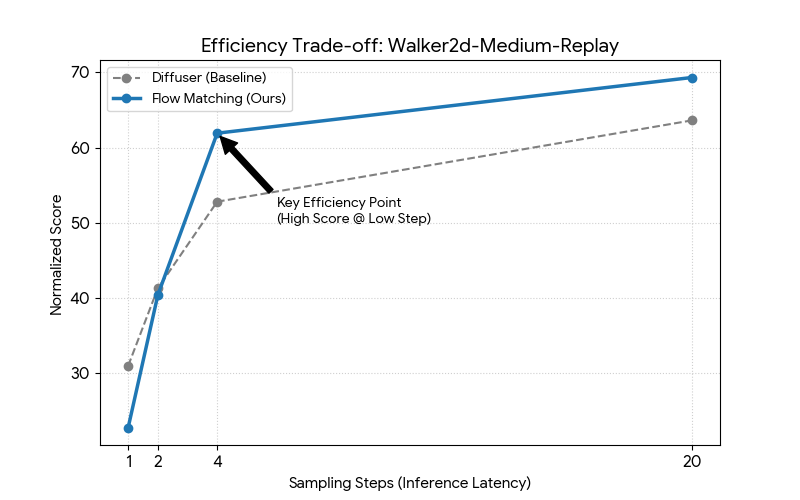
- 5× fewer sampling steps. At 4 steps, flow matching holds 61.9 on Walker2d-Medium-Replay while diffusion drops to 52.8.
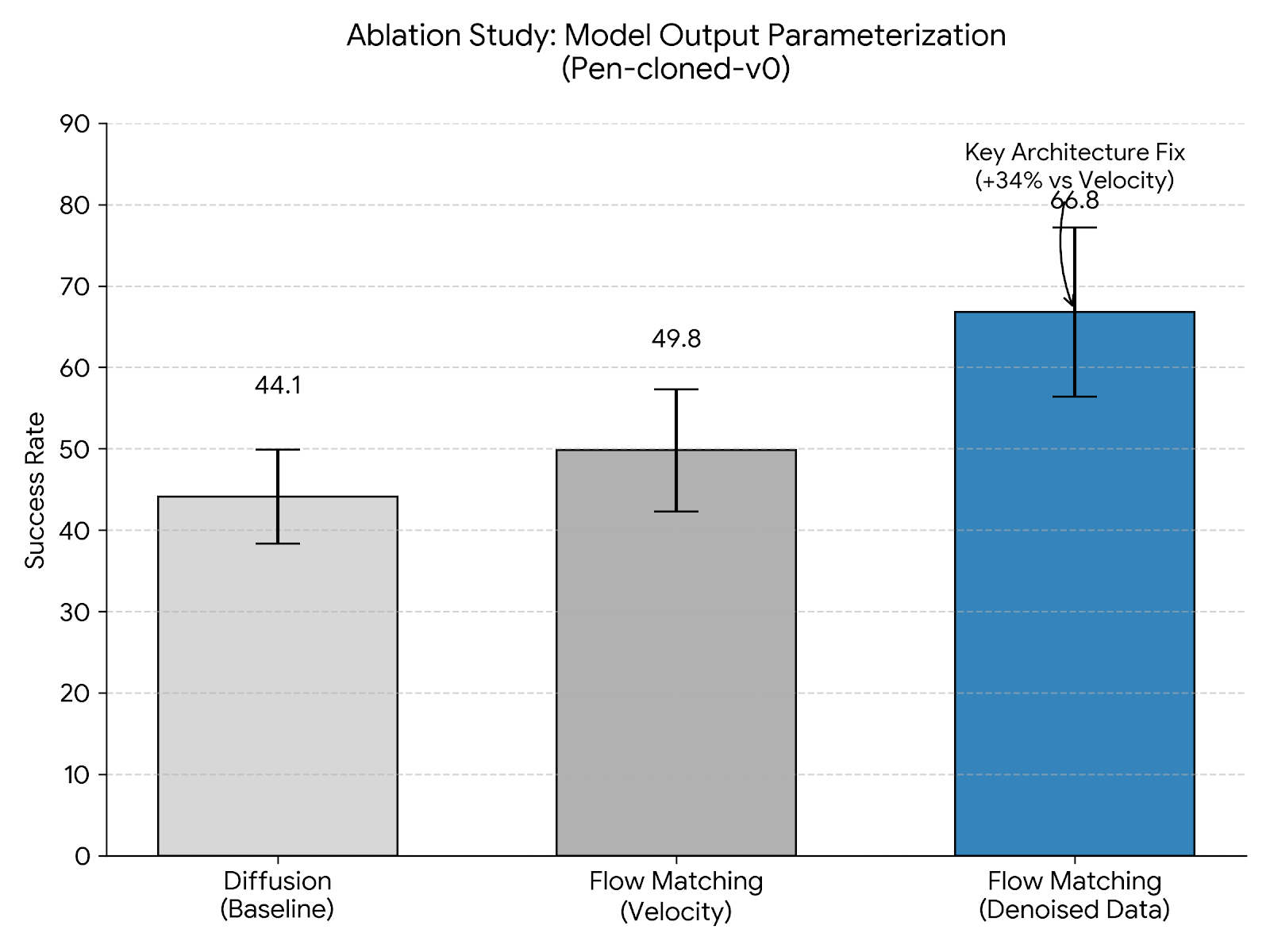
- Predicting denoised data (x̂₀) instead of velocity raised Pen-cloned from 49.8 → 66.8, against a diffusion baseline of 44.1.
- Advantage-based guidance from IQL-trained Q and V functions, for lower-variance trajectory steering.
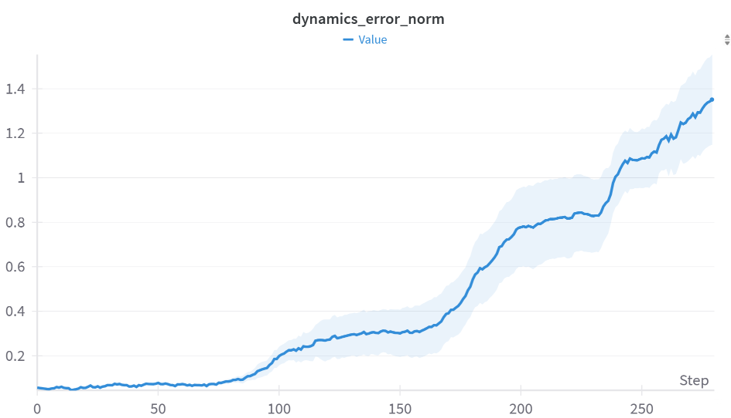
- Found that dynamics error climbs after ~100 steps of open-loop execution, which led to the replanning work in Mean Flow × DTAMP.
Write-up
3 min readProblem
Diffuser (Janner et al.) plans by denoising a whole trajectory with a diffusion model. The plans are good, but each one costs dozens of denoising steps, which is too slow for a control loop that has to replan at 50 Hz or more. Cutting the step count on the stock model is not an option: on Franka Kitchen (kitchen-partial-v0), Diffuser scores 44.7 at 16 steps but falls to 35.7 at 4 steps and 33.5 at 1 step.
During my internship at the SNU Robot Learning Lab, I set out to make Diffuser fast enough for real-time replanning without giving up plan quality.
Approach
I made three changes to the jannerm/diffuser codebase.
Flow matching with optimal-transport paths. I replaced the diffusion process with flow matching and used the optimal-transport conditional path, which moves each sample along a straight line between noise and data. Straight paths are easier to learn and hold up better when integrated with only a few large steps.
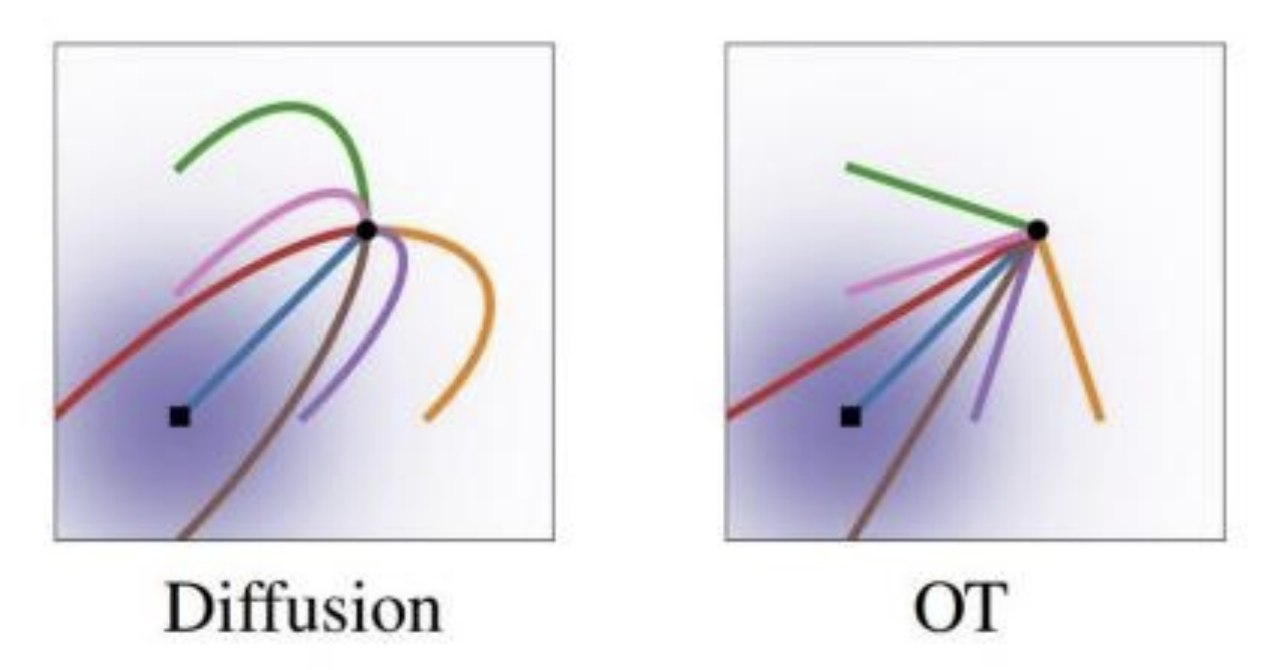
Predicting clean data instead of velocity. Diffuser can predict either the noise or the denoised trajectory. Standard flow matching predicts the velocity $v_t$. I suspected that with Diffuser’s temporal U-Net, predicting the clean trajectory $\hat{x}_0$ directly would give a lower-variance target that makes better use of the temporal structure. The velocity needed for integration is then recovered as
\[v_t = \frac{\hat{x}_0 - x_t}{1 - t},\]where $x_t$ is the current sample and $t \in [0, 1]$ is normalized time, with $t = 1$ at the data.
Advantage-based guidance. Diffuser steers sampling with a value estimate of the whole trajectory. That estimate has high variance and reflects the behavior policy rather than the optimal one. Instead, I trained separate $Q$ and $V$ functions with Implicit Q-Learning (IQL) and guided sampling with the gradient of the advantage $A(s, a) = Q(s, a) - V(s)$, pushing generation toward higher-advantage actions.
Results
Fewer steps. On Walker2d-Medium-Replay, going from 20 to 4 sampling steps drops Diffuser from 63.6 to 52.8. The flow-matching planner goes from 69.3 to 61.9. Four steps is a 5× reduction in sampling cost, and at that setting the flow-matching planner still does nearly as well as Diffuser does at 20 steps. Below 4 steps, both models degrade sharply.
Output parameterization. On the high-dimensional Adroit Pen-cloned-v0 task, velocity prediction was the weak point. Switching to clean-data prediction raised the score from 49.8 to 66.8, about a 34% relative gain, against a diffusion baseline of 44.1.
Where open-loop plans break. Faster sampling alone does not fix drift. When I tracked the gap between planned and actual dynamics over an episode, the error stayed near zero for about 100 steps, then climbed steadily with two sharp jumps later on. Beyond that horizon, executing a plan open-loop is unreliable.
Takeaways
- Flow matching with straight OT paths gives a practical speed-quality trade-off: 4 steps is a workable setting for replanning at control rates.
- The prediction target matters as much as the generative framework. Predicting clean data acted as an implicit regularizer and mattered most in high-dimensional manipulation.
- The dynamics-error analysis showed that plans need refreshing before roughly 100 steps. That result motivated my follow-up work on real-time replanning with Mean Flow and DTAMP.